
Predicting the future isn’t hard. Getting the future to stick to the schedule. That’s another story.
Some predictions age badly. Others, like this one, age strangely: they got the direction right and missed the calendar for reasons nobody could have put into the equation.
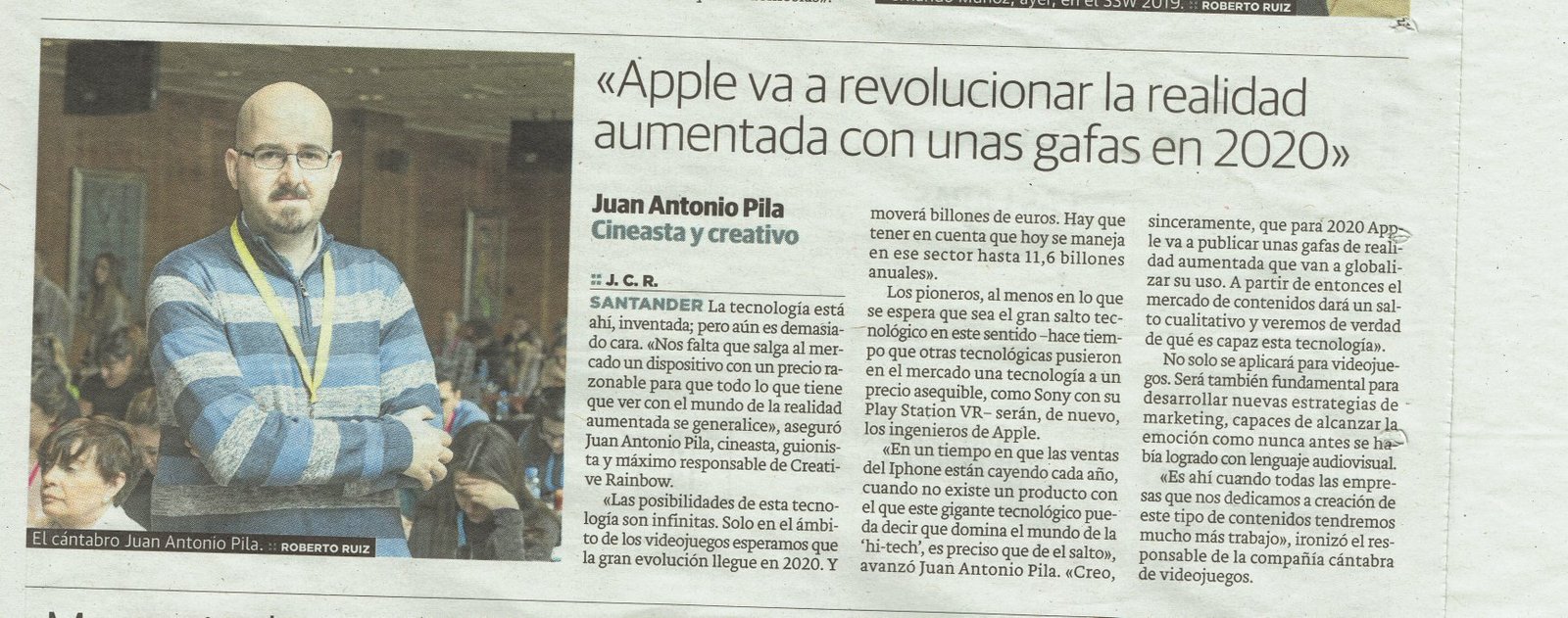
Back in 2019, during a technology conference in Santander, I was interviewed by El Diario Montañés, one of northern Spain’s leading regional newspapers. Among other things, I said this:
«Las posibilidades de esta tecnología son infinitas. Solo en el ámbito de los videojuegos esperamos que la gran evolución llegue en 2020. Y moverá billones de euros.» («The possibilities of this technology are endless. In gaming alone, we expect the big breakthrough to arrive in 2020. And it will move billions of euros.»)
And then, going even further out on a limb:
«Sinceramente, que para 2020 Apple va a publicar unas gafas de realidad aumentada que van a globalizar su uso.» «Honestly, by 2020 Apple will release augmented reality glasses that will take the technology mainstream.»
The first part came true: augmented reality moves figures with plenty of zeros attached. The second… let’s say the calendar didn’t cooperate. In 2020, while Apple was preparing its leap, the entire planet locked itself indoors and every roadmap in the industry froze. No glasses, no launches, no trade shows: the pandemic wiped out anything with the word «2020» written on it.
The glasses, when they finally arrived with the Vision Pro, did so years late and — as with nearly everything that arrives late — in a world slightly different from the one I had imagined.
Do I draw any conclusions from this? Two. First: in technology, getting the what right is the easy part — the industry’s inertia tends to be readable. Nailing the when is impossible. Second: reading your own decade-old predictions is the most entertaining humility exercise there is.
Interview by J.C.R. published by El Diario Montañés, Santander, Spain. Photography by Roberto Ruiz.